
Calculators & Tools
Apps for smarter, safer spraying
About the tools
Explore decision-support tools, unit converters, productivity and calibration calculators, searchable databases and other resources designed to make agricultural spraying safer, more effective and more efficient. Select a topic from the list to launch an app on your desktop or mobile device.
Contents
Tank Mix Calculator
Sprayer math lets you estimate job time, spray mix volume, product needed, and sprayer tank mix records

OrchadMAX 2.0
Free decision-support tool for apple growers to match airblast sprayer output to canopy
Drone Productivity Calculator
Measure productivity as a complete application system, not just flight settings
Air Displacements Calculator
Accurately measure average travel speed using GPS, radar, or the 50 m timed run
Boom Sprayer Calibration
Determine broadcast label rate and spray volume per hectare to use as basis for banded calculations
Airblast Sprayer Calibration
Calibration covers three activities: sprayer maintenance inspection, adjusting sprayer configuration, and validating sprayer output
Plot Sprayer Calibration
To scale an airblast carrier for small plots you must know treated area, sprayer emission rate, and desired airblast carrier volume
Greenhouse Fogging Calculator
UV dyes better detect fog deposits than water sensitive paper
Sprayer Unit Converter
Canada’s sprayer world mixes Metric and US Imperial, causing confusing calibration questions and painful unit conversions
Airblast Productivity Calculator
Use the Airblast Budget and Work Rate Calculator to compare scenarios
Available tools
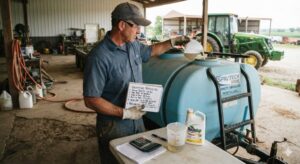
Tank Mix Calculator
Sprayer math lets you estimate job time, spray mix volume, product needed, and sprayer tank mix records for traceability. Follow these steps: calculate area, determine product rate, compute area per tank, pesticide per tank, remaining area, and partial-tank amounts. Use the tank mix calculator to simplify calculations. Read more.

OrchardMAX 2.0
Free decision-support tool for apple growers to match airblast sprayer output to canopy, achieving about 20 to 35% seasonal spray-volume savings in trials. Estimates carrier volume, pesticide dose, nozzle flow rates, tank needs, and work rate; accepts metric or US customary units. Decision-support only: does not replace sprayer calibration, operator judgment, or pesticide labels; will not recommend rates outside label or below ~400 L/ha. Read more.
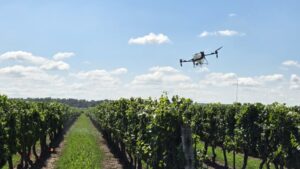
Drone Productivity Calculator
Measure productivity as a complete application system, not just flight settings. Tendering tasks such as water refills, battery swaps, fill times, and ferrying distance affect downtime; small improvements compound into large productivity gains. Use the calculator to test variables; swath and speed are limited by agronomics, so tender capacity and staging often determine real output. Read more.
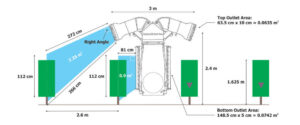
Air Displacements Calculator
Accurately measure average travel speed using GPS, radar, or the 50 m timed run; wheel speedometers can be fooled. Calculate volumetric flow: measure outlet area and air speed, convert to m3/h, then compare to target displacement volume. Use Dwell Time: set travel speed so spray-laden air replaces canopy air long enough for penetration but not so long it causes blow-through. Treat the model as a guide: fine tune with ribbon tests and water sensitive paper, adjust sprayer, canopy, or weather if mismatch occurs. Read more.
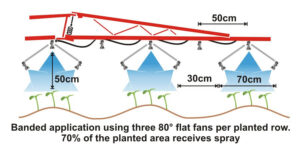
Boom Sprayer Calibration
Determine broadcast label rate and spray volume per hectare to use as basis for banded calculations. Calculate actual sprayed area using band width divided by row width times planted area to determine reduced product required. Compute nozzle output from broadcast output, speed, swath width, and nozzles; watch units and use correct formula constants. Select nozzle from catalogue for desired spray quality and swath, operate mid pressure range, then calibrate and adjust speed or pressure as needed. Read more.
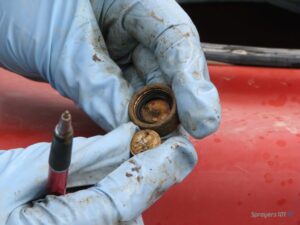
Airblast Sprayer Calibration
Calibration covers three activities: sprayer maintenance inspection, adjusting sprayer configuration, and validating sprayer output. Do all three regularly to ensure safe, effective, and efficient pesticide applications. Validation confirms nozzle rates and travel speed; perform at season start and after any significant sprayer change. Adjust settings as conditions and crops change; use assignment and spray order strategies to reduce adjustments and prevent malfunctions. Read more.
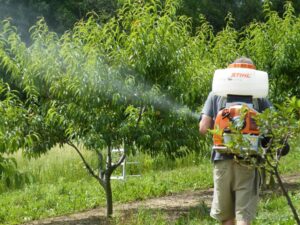
Plot Sprayer Calibration
To scale an airblast carrier for small plots you must know treated area, sprayer emission rate, and desired airblast carrier volume. Three-dimensional targets need spraying from multiple sides or circling until consistent coverage is achieved; uniform boom height and pace are critical for 2D targets. Calibrate by measuring sprayer output using timing or weight, convert units, compute required volume for the area, then calculate spray time in seconds. Read more.
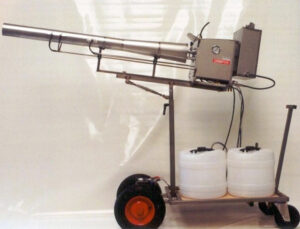
Greenhouse Fogging Calculator
Droplet size determines behavior: mist 50–100 μm, fog under 50 μm; UV dyes better detect fog deposits than water sensitive paper. Increase contact via chemical spreaders like nonionic surfactants or mechanical breakup and use greenhouse airflow to circulate droplets for canopy penetration. Choose proper equipment and follow maintenance: HV, LV, ULV differences, avoid thermal pulse for bio products unless cooled, aim fog between plants, follow labels. Read more.
Sprayer Unit Converter
Canada’s sprayer world mixes Metric and US Imperial, causing confusing calibration questions and painful unit conversions. This new Sprayer Calibration and Unit Conversion Tool converts many agriculturally relevant units and simplifies common calibration tasks. Read more.
Airblast Productivity Calculator
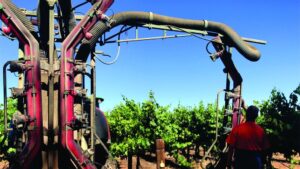
Use the Airblast Budget and Work Rate Calculator to compare scenarios; change one variable at a time to understand cost and productivity trade-offs. Small changes like row length or filling strategy can save money, but travel speed usually has only marginal impact on overall work rate. Highly efficient sprayers, like the five-row OXBO 7550, can spray ~150 L/ha at 13 km/h and cover almost 15 hectares per hour. Design compromises like swept-back or overhead heads trade ideal coverage for smaller turn radius and less spray deposition on the sprayer, improving productivity. Read more.